

Many patients tell me:
“I’ve tried brightening skincare, but the pigmentation keeps coming back.”
Here’s the reality:
Most pigmentation cannot be fully treated with skincare alone.
To effectively manage it, we often need medical-grade treatments like lasers.
What Causes Pigmentation?
Pigmentation occurs when your skin produces excess melanin. Common triggers include:
- Sun exposure (UV damage)
- Acne scars (post-inflammatory pigmentation)
- Hormonal changes (melasma)
- Aging and environmental stress
Each type of pigmentation behaves differently, which is why choosing the right laser is important.
Types of Pigmentation (And Why It Matters)
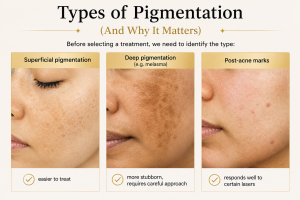
Before selecting a treatment, we need to identify the type:
- Superficial pigmentation → easier to treat
- Deep pigmentation (e.g. melasma) → more stubborn, requires careful approach
- Post-acne marks → responds well to certain lasers
💡 Treating the wrong type with the wrong laser can worsen the condition. Especially for Asian skin.
Best Laser Treatments for Malaysian Skin
1. Pico Laser – For Stubborn Pigmentation & Overall Brightening
Pico laser is one of the most advanced technologies for pigmentation.
It uses ultra-short pulses to break down pigment without overheating the skin making it safer for darker skin tones.
Best for:
- Melasma
- Sunspots
- Uneven skin tone
- Overall brightening
✔ Minimal downtime, gradual improvement
2. Q-Switched Laser – For Gentle, Progressive Treatment
Q-switched laser is a well-established treatment, especially for Asian skin.
It works gradually, making it ideal for patients who prefer low downtime and consistent improvement.
Best for:
- Mild pigmentation
- Maintenance treatments
- Sensitive skin
✔ Safe, gentle, but requires multiple sessions
3. Fractional Laser – For Pigmentation + Texture Improvement
If your pigmentation comes with acne scars or rough texture, fractional lasers are a better option.
They work by resurfacing the skin and stimulating collagen.
Best for:
- Acne scars + pigmentation
- Uneven skin texture
- Enlarged pores
✔ More downtime, but more dramatic results
4. Laser Toning – For “Glass Skin” Effect
Laser toning is a popular choice for patients who want clear, radiant skin without aggressive treatment.
Best for:
- Dull skin
- Uneven tone
- Early pigmentation
✔ No downtime, instant glow effect
Why One Laser Is Not Enough
One of the biggest misconceptions is:
👉 “I just need one laser treatment to fix everything.”
In reality, pigmentation especially in Malaysian skin are often requires:
- Multiple sessions
- Combination treatments
- Maintenance
For example:
- Pico laser + skin boosters
- Laser toning + chemical peel
- Fractional laser + regenerative treatments
✔ This approach gives better, longer-lasting results
Important: Why Malaysian Skin Needs a Careful Approach
Asian skin is more prone to:
- Post-inflammatory hyperpigmentation (PIH)
- Sensitivity after aggressive treatments
This means:
⚠️ Stronger is NOT always better
⚠️ Over-treatment can worsen pigmentation
💡 A customised treatment plan is essential.
What Results Can You Expect?
With the right treatment plan, you can expect:
- Brighter, more even skin tone
- Reduction in dark spots
- Smoother, clearer complexion
However, pigmentation management is a journey, not a one-time fix.
Final Thoughts from Dr. Nadia Elaiza
Pigmentation is one of the most common, and most misunderstood skin concerns.
The key is not just choosing a laser, but choosing the right laser for your specific condition.
With proper treatment and maintenance, achieving clear, radiant skin is absolutely possible.
Ready to Treat Your Pigmentation?
The best way to start is with a professional skin assessment.
Because when it comes to pigmentation,
precision matters more than power.
Dr. Nadia Elaiza Norisam (MD)
Medical Director
Board Certified Aesthetic Physician (LCP, MOH)
PG Dip Clinical Dermatology (QMUL, UK)
PG Dip Aesthetic Medicine (AAAM, US)
Hampshire Clinic Malaysia